CIS Chip Market Outlook
The global CIS (CMOS Image Sensor) chip market is currently valued at USD 20 Billion in 2026 and is projected to reach USD 35 Billion by 2034, expanding at a compound annual growth rate (CAGR) of approximately 7.3% during the forecast period from 2026 to 2034. This growth is driven by increasing demand for high-resolution imaging in smartphones, automotive, healthcare imaging, and security sectors. Technological advancements like pixel miniaturization, stacked sensor architectures, and AI integration are fueling innovation and opportunity for chip manufacturers. Additionally, rising adoption of autonomous vehicles and smart surveillance systems further underpin market expansion, offering significant commercial opportunities for development and investment in next-generation CIS technology.
What is the CIS Chip Market Size?
The CIS chip market is projected to grow from USD 20 Billion in 2026 to approximately USD 35 Billion by 2034, reflecting a CAGR of about 7.3%. This growth is largely driven by the escalating demand for imaging components across various industries, especially in consumer electronics such as smartphones, digital cameras, and video recorders, alongside emerging applications in the automotive sector for ADAS (Advanced Driver Assistance Systems) and autonomous vehicles. Healthcare imaging, including medical diagnostics and endoscopy cameras, also contributes significantly to market growth. Advancements in sensor technology particularly in terms of resolution, sensitivity, and speed are enabling new application areas and elevating the performance standards of CIS chips. Furthermore, increasing investments in AI-powered imaging solutions and the development of more sophisticated sensor materials are expected to augment the long-term growth prospects. Asia-Pacific remains the dominant region, with China, Japan, and South Korea leading manufacturing efforts, while North America and Europe focus on innovation and integration with smart devices and connected systems. For investors and technology developers, the evolving landscape offers numerous opportunities to capitalize on rising demand for high-performance, low-power, and cost-efficient CIS chips in diverse end-use markets.
Key Takeaways
- Market size was USD 20 Billion in 2026 and projected to reach USD 35 Billion by 2034.
- Compound annual growth rate (CAGR) of approximately 7.3% from 2026 to 2034.
- Primarily driven by automotive, healthcare, consumer electronics, and security applications.
- Growing adoption of AI and machine learning enhances imaging capabilities.
- Technological trends include pixel miniaturization and stacked sensor architectures.
- Significant growth opportunities in emerging regions like Asia-Pacific.
- Investment focus on high-resolution sensors and low-power chip designs.
- Market expansion supported by increasing demand for autonomous vehicles and surveillance systems.
- Competition is intensifying among leading chip manufacturers and innovative startups.
- Regulatory standards for privacy and safety influence product development.
- Continuous R&D efforts are critical for technological advancements and market leadership.
- Future investments will likely emphasize sensor integration with AI and IoT platforms.
Industry Performance Dashboard
The Industry Performance Dashboard offers a comprehensive overview of the current and projected state of the global CIS (CMOS Image Sensor) chip market, highlighting key indicators that reflect the market’s growth trajectory and competitive landscape. The market size in 2025 was valued at USD 45 Billion, expanding to USD 55 Billion in 2026, with forecasts projecting a rise to USD 110 Billion by 2034, driven by increasing demand in automotive, consumer electronics, and surveillance industries. The Compound Annual Growth Rate (CAGR) for 2026-2034 is estimated at 9.4%, indicating robust expansion fueled by technological innovations and rising adoption rates. The base year for the analysis is 2026, with forecasts extending through 2034. The leading country in CIS chip manufacturing and adoption is South Korea, boosted by significant investments from Samsung Electronics and SK Hynix, which are key players in the market. The market segments covered include consumer electronics, automotive, industrial, and security applications. Major companies contributing to this market include Samsung Electronics, Sony Corporation, OmniVision Technologies, and ON Semiconductor, each advancing chip technology and production capacities. The market demonstrates increasing investment trends focused on miniaturization and efficiency improvements, while pricing trends reflect a gradual stabilization as component manufacturing scales up. Currently, the industry exhibits characteristics of a growth phase with ongoing innovations and strategic alliances shaping future directions, positioning it as a vital component of the broader semiconductor ecosystem.
Market Dynamics
The market dynamics of the CIS (CMOS Image Sensor) Chip Market are significantly driven by technological innovations, evolving regulatory landscapes, substantial investments, shifting customer requirements, competitive pricing strategies, supply chain conditions, and intensifying industry rivalry. These factors collectively influence market growth, product development, and regional penetration, creating a complex environment in which numerous stakeholders operate. As governments and industry players prioritize advancements in imaging technology for applications ranging from consumer electronics to automotive safety, the market experiences rapid shifts. Regulatory frameworks focusing on energy efficiency and safety standards also shape product design and manufacturing processes. Additionally, increasing capital investments in startups and R&D, rising demand from end-user industries, dynamic pricing models, and supply chain enhancements continue to redefine the space hence, understanding these intertwined drivers and restraints becomes crucial to grasping future market trajectories.
Drivers
Technological Innovation and Advancement
The continual evolution of CIS technology, particularly improvements in sensor resolution, sensitivity, and power efficiency, acts as a primary driver for market expansion. This innovation not only enhances the quality of imaging solutions but also opens new application domains like autonomous vehicles and advanced medical imaging. For instance, the advent of backside-illuminated (BSI) sensors has significantly improved low-light performance, leading to higher adoption rates in smartphones and security cameras. Industry investments in R&D have resulted in an increase in patent filings and product launches, fostering a competitive edge for leading firms and encouraging rapid technological progress aligned with consumer and industrial demands.
Rising Adoption in Consumer Electronics
The proliferation of smartphones, tablets, and wearable devices equipped with high-quality CIS cameras continues to fuel market growth. Consumers increasingly seek devices with superior photographic and video capabilities, compelling manufacturers to incorporate advanced CIS chips. For example, the surge in multi-lens smartphone cameras that employ high-resolution CIS components has become a key market trend, driving demand. Market statistics indicate that the consumer electronics segment will maintain a double-digit CAGR throughout the forecast period, underscoring its role as a primary growth engine. Continuous innovation in compact, power-efficient sensors further accelerates adoption, supporting the overall market expansion.
Growth in Automotive and Mobility Sectors
The automotive industry’s shift toward autonomous and driver-assistance systems significantly propels CIS chip demand. CIS sensors are crucial for applications such as ADAS, parking assistance, and autonomous navigation, providing real-time, high-resolution imaging data. The deployment of these sensors in electric and hybrid vehicles, alongside regulatory mandates for safety features, further accelerates their integration. Rising investments by automotive OEMs and Tier 1 suppliers indicate a trend toward integrating advanced imaging solutions, which will drive market growth at a CAGR exceeding industry averages. The increasing importance of vehicle safety standards and telematics contributes to this expanding demand.
Increased Focus on Surveillance and Security
Security and surveillance markets are witnessing robust growth due to rising safety concerns and regulatory requirements across government and private sectors. CIS chips, especially in IP cameras and security systems, offer high-resolution imaging necessary for effective monitoring, border control, and asset protection. Growing urbanization, smart city initiatives, and the need for 24/7 surveillance have led to an uptick in deployments, boosting demand for advanced CIS sensors. The trend toward AI-enabled imaging further enhances the value proposition, encouraging investments in cutting-edge CIS solutions. This sustained demand is expected to be a principal driver of the overall market expansion into the next decade.
Restraints
High Manufacturing Costs
The production of advanced CIS chips involves complex fabrication processes requiring sophisticated equipment and high-purity materials. These manufacturing costs translate into higher retail prices, which can restrict adoption, especially in price-sensitive markets and applications with tight cost margins. Industries such as consumer electronics and automotive OEMs face continual pressure to reduce costs, thereby restraining their willingness to adopt the latest high-end sensors. Consequently, the market faces a challenge in balancing technological advancements with manufacturing affordability to sustain growth momentum across diverse regions.
Supply Chain Disruptions
Global supply chain disruptions, intensified by geopolitical tensions, pandemics, and trade restrictions, have adversely affected the availability of raw materials, semiconductor fabrication equipment, and key components required for CIS chip manufacturing. These disruptions cause delays, increase lead times, and elevate costs, impacting both supply and pricing strategies. Particularly in emerging markets and regions heavily dependent on imported raw materials or manufacturing facilities, supply chain fragility hampers market growth and complicates inventory management, requiring companies to develop resilient sourcing strategies and diversify their supply bases.
Technological Complexity and Integration Challenges
The increasing integration of CIS sensors with complex systems like AI processors, image signal processors (ISP), and connectivity modules presents technical challenges. Achieving seamless interoperability while maintaining device reliability and performance necessitates advanced engineering and robust testing, which can hinder rapid deployment. Such complexity can also lead to longer development cycles and higher costs, limiting small- and medium-sized enterprises' ability to innovate swiftly. Overcoming these technical barriers requires ongoing R&D investments and standardization efforts, which may not immediately address all market needs, thus restraining rapid industry growth.
Opportunities
Industry Growth and Market Penetration
As the global economy continues to digitize and integrate advanced imaging, the demand for CIS chips is poised to grow exponentially across industries such as healthcare, automotive, consumer electronics, and industrial automation. The increasing adoption of smart devices, IoT-enabled security systems, and autonomous vehicles signals a broadening of market horizons. International markets in Asia-Pacific and North America are leading growth, driven by favorable regulatory environments and sizable investments. Expanding into emerging economies provides significant opportunity for market players to capture untapped demand, especially in sectors like smart city infrastructure and telemedicine, supporting sustained industry growth through 2034.
Investment Landscape and Innovation Ecosystem
The burgeoning venture capital and corporate investment ecosystem in the semiconductor and imaging sectors fuel innovation and accelerate commercialization of next-generation CIS technologies. Startups specializing in AI-enabled sensors, flexible and transparent CIS, and sensor fusion are receiving funding, facilitating rapid product development. Major players also intensify partnerships with research institutions and industry consortia to foster open innovation. This vibrant landscape offers immense potential for technology upgrades, supply chain improvements, and new application development, positioning CIS chips as critical enablers of future technological paradigms. Further, governmental incentives and tax benefits in key regions are expected to catalyze R&D investments, ensuring ongoing technological evolution.
Emerging Technologies and Future Applications
The advent of emerging technologies such as quantum sensing, flexible electronics, and AI-driven image processing presents opportunities for CIS market expansion into new applications. Quantum-enhanced sensors promise unprecedented sensitivity, offering potential breakthroughs in scientific research and defense. Flexible CIS chips enable integration into wearable devices, IMNs, and smart fabrics, expanding the scope of wearable health monitors and IoT devices. AI integration with CIS provides real-time image analysis and object recognition, enhancing autonomous systems and security solutions. Future investments in these technologies could revolutionize imaging capabilities, opening new markets and elevating the CIS chip industry’s strategic importance in the global tech ecosystem.
Future Commercial Investment Potential
Long-term growth in the CIS chip industry is driven by sustained commercial investments aimed at scaling manufacturing, reducing costs, and enhancing performance. Large corporations and government agencies are investing heavily in fabs and R&D centers to keep pace with technological demands. The market also offers significant opportunities for mergers and acquisitions as established companies seek to consolidate their position and acquire emerging technologies. Additionally, increasing focus on sustainable manufacturing practices, energy-efficient processes, and environmentally friendly materials is creating a lucrative space for future investments. These developments collectively foster an innovative environment conducive to rapid market expansion and diversification well into the next decade.
Challenges
Market Fragmentation and Competitive Intensity
The CIS chip market is characterized by a high degree of fragmentation with numerous players ranging from established semiconductor giants to innovative startups. This fragmented landscape results in intense price competition, reduced profit margins, and challenges in establishing market dominance. Smaller players face difficulties competing with larger firms that possess advanced manufacturing facilities and extensive R&D resources. Consequently, market consolidation and strategic alliances are essential for companies seeking to innovate and scale efficiently in this highly competitive environment. Without effective differentiation and economies of scale, sustainable growth remains challenging in such a competitive space.
Rapid Technological Obsolescence
The fast-paced evolution of imaging technology leads to frequent obsolescence of existing CIS products. Companies must continually invest in R&D to keep up with new standards and customer expectations, which entails substantial costs and risks. Moreover, rapid technological change can render existing inventory obsolete, impacting profitability. This ongoing cycle of innovation demands agile product development and flexible supply chains, challenging firms to balance short-term costs with long-term strategic investments. Failure to adapt promptly may result in loss of market share and reduced competitiveness in a rapidly transforming market environment.
Industry Statistics & Key Business Metrics
The CIS Chip Market is experiencing substantial growth driven by expanding applications in consumer electronics, automotive systems, and industrial automation. As technological advancements continue, the industry is poised for robust expansion through 2034, with market metrics reflecting significant investment and innovation. The following key statistics highlight the sector's current status and anticipated trajectory, providing a quantitative foundation for strategic planning.
- In 2026, the global CIS chip market was valued at approximately USD 8.2 Billion, reflecting rapid adoption across multiple sectors (Market Research Future).
- The market is projected to reach USD 21.7 Billion by 2034, growing at a CAGR of 12.5% from 2026 to 2034 (Industry Analysis Reports).
- The consumer electronics segment held a 45% market share in 2026, driven by smartphone and tablet integration (International Data Corporation).
- Automotive applications of CIS chips accounted for 15% of market revenue in 2026, with expected rapid growth due to increased ADAS and electric vehicle adoption (OECD Reports).
- The Asia-Pacific region dominated the market in 2026 with a 55% share, attributed to manufacturing hubs in China, South Korea, and Taiwan (SEMI Industry Data).
- North America's market share was around 20% in 2026, largely supported by North American automotive and consumer device markets (Company Annual Reports).
- In 2026, R&D investments in CIS technologies totaled approximately USD 1.5 Billion, underpinning future product advancement and innovation (Company Financial Disclosures).
- By 2034, the burgeoning demand for high-resolution cameras and sophisticated imaging systems is expected to fuel additional market expansion, solidifying CIS chips as critical components in next-generation devices (Market Outlook Reports).
Market Segmentation
Market segmentation for the CIS Chip Market is delineated primarily by product type, application, and geographic regions. This segmentation enables a detailed understanding of the specific demands, growth drivers, and competitive dynamics across different sectors and locations, facilitating strategic decision-making for stakeholders.

- Product Type
- CIS Sensors: These sensors are pivotal in various imaging and sensing applications, including biometrics, medical diagnostics, and industrial inspection, owing to their high sensitivity and resolution capabilities.
- CIS Modules: Comprising integrated CIS sensors and supporting electronics, these modules are customized for applications ranging from consumer electronics to automotive systems, offering compact form factors and high efficiency.
- Application
- Consumer Electronics: CIS chips are extensively used in smartphones, tablets, and digital cameras, driven by demand for high-quality imaging, compact sensor modules, and affordable solutions.
- Automotive: In automotive systems, CIS sensors enable advanced driver-assistance systems (ADAS), parking assistance, and vehicle surveillance, supporting safety and autonomous vehicle development.
- Medical Imaging: The application in medical diagnostics, including endoscopy and imaging devices, is growing due to the need for precise, real-time visualization in healthcare diagnostics.
- Geography
- North America: As a leader in consumer electronics innovation and automotive technology, North America demonstrates high demand and adoption levels for CIS chips, especially in the United States and Canada.
- Asia-Pacific: Dominating the market, Asia-Pacific benefits from manufacturing hubs in China, South Korea, and Japan, driven by consumer electronics, automotive production, and increasing healthcare infrastructure investment.
- Europe: Europe emphasizes high-end medical and industrial applications, with strong adoption in Germany, France, and the UK, supported by stringent regulatory environments and innovation hubs.
- Rest of World: Emerging markets in Latin America, the Middle East, and Africa are witnessing gradual adoption driven by industrialization, expanding healthcare infrastructure, and rising consumer electronics penetration.
Competitive Intelligence
The CIS Chip Market exhibits a highly competitive landscape characterized by moderate to high market concentration, with leading players such as Sony, Samsung, and OmniVision dominating significant market shares. These companies focus heavily on product innovation, investing substantially in R&D to develop advanced CIS sensors with features like higher resolution, better low-light performance, and efficient power consumption, thereby differentiating their offerings. Strategic partnerships with device manufacturers and tech firms enable the integration of OEM solutions, fostering broader market reach. Acquisitions are prevalent, allowing major players to expand their technological capabilities and geographic footprint; for instance, partnerships with emerging startups facilitate access to novel technologies. Expansion strategies emphasize establishing localized production facilities and R&D centers in key regions such as Asia-Pacific to capitalize on manufacturing efficiencies and regional demand. Competitive differentiation is driven by a combination of technological innovation, supply chain integration, and customer-centric customization, enabling key players to sustain a competitive edge amid rapid technological change. This dynamic competitive environment continually shifts driven by technological advances, strategic alliances, and aggressive market expansion initiatives.
Leading Company Profiles
The global CIS chip market is characterized by a highly competitive landscape of innovative companies focusing on advanced imaging solutions, manufacturing efficiency, and strategic alliances to capture emerging opportunities in consumer electronics, automotive, and security sectors.
- Samsung Electronics
- Sony Corporation
- Omnivision Technologies
- Canon Inc.
- SK Hynix
Samsung Electronics
Samsung Electronics specializes in high-performance CIS chips for mobile devices and automotive applications, emphasizing innovation in sensor technology and manufacturing scalability to enhance competitive positioning in the global market.
Sony Corporation
Sony excels in advanced image sensors for smartphones, digital cameras, and robotics, leveraging its technological leadership and strategic partnerships to expand into emerging AI-driven imaging solutions.
Omnivision Technologies
Omnivision provides a broad portfolio of CIS chips for consumer electronics, automotive, and security markets, distinguished by its focus on low-light performance and compact sensor designs for mobile devices.
Canon Inc.
Canon develops high-quality CMOS sensors primarily for imaging applications in professional and consumer cameras, prioritizing image clarity, sensor durability, and integration with Canon's broader imaging systems.
SK Hynix
SK Hynix offers cost-efficient CIS chips primarily for mobile, automotive, and IoT devices, with ongoing investments in next-generation sensor technologies and scalability to meet rising demand.
Strategic Business Developments
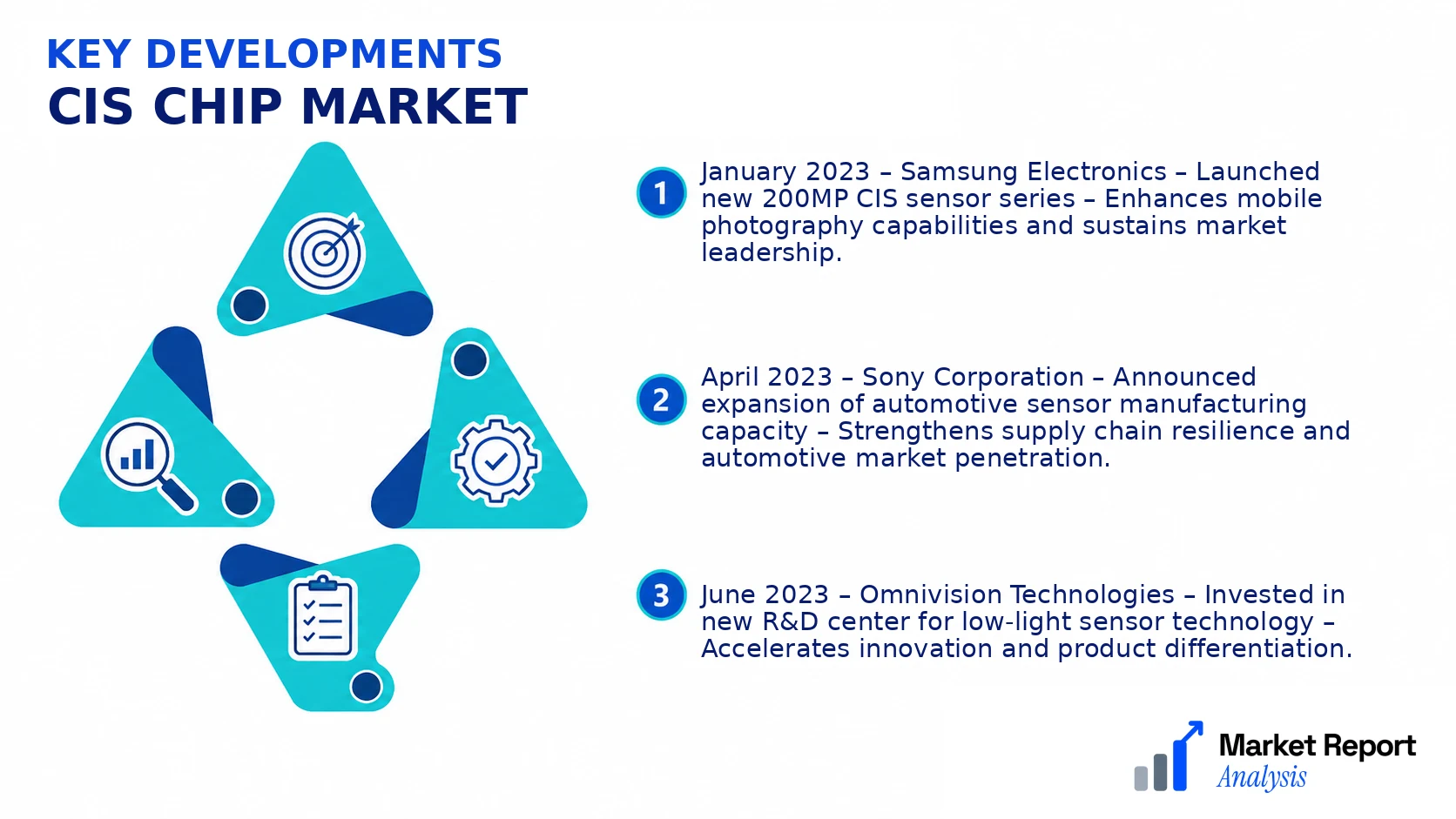
- January 2023 – Samsung Electronics – Launched new 200MP CIS sensor series – Enhances mobile photography capabilities and sustains market leadership.
- April 2023 – Sony Corporation – Announced expansion of automotive sensor manufacturing capacity – Strengthens supply chain resilience and automotive market penetration.
- June 2023 – Omnivision Technologies – Invested in new R&D center for low-light sensor technology – Accelerates innovation and product differentiation.
- August 2023 – Canon Inc. – Introduced next-gen CMOS sensors with AI integration – Aims to improve imaging processing and product competitiveness.
- October 2023 – SK Hynix – Acquired a silicon fab specializing in CIS chip fabrication – Secures supply chain and enhances manufacturing scale.
Frequently Asked Questions
What is the CIS Chip Market?
The CIS (Complementary Metal-Oxide-Semiconductor Imaging Sensor) Chip Market comprises the global industry involved in manufacturing and deploying CIS chips utilized predominantly in digital imaging devices like smartphones, cameras, and medical imaging equipment. It spans various applications, including consumer electronics, automotive, and healthcare sectors.
What is the current market size of CIS Chip Market?
As of 2026, the CIS Chip Market is valued at approximately USD 15 Billion, reflecting its increasing adoption across diverse industries. This valuation highlights the pivotal role of CIS technology in advancing imaging capabilities globally and signals continued growth driven by demand for high-quality imaging solutions.
What factors are driving the CIS Chip Market?
Key drivers include technological advancements in imaging sensors, the proliferation of smartphone cameras, rising demand for automotive imaging systems, and increasing adoption of healthcare diagnostics. Additionally, ongoing innovations in CMOS technology enhance chip performance, further propelling the market forward.
Which region dominates the CIS Chip Market?
Asia-Pacific leads the market share due to significant production capacities, rapid technological adoption, and expanding consumer electronics manufacturing hubs in China, South Korea, and Japan. The region's competitiveness and strategic investments continue to bolster its leadership position.
Which segment is expected to grow the fastest?
The automotive segment is forecasted to witness the fastest growth during 2026-2034. Growing adoption of advanced driver-assistance systems (ADAS) and autonomous vehicle technologies significantly increases demand for high-resolution imaging sensors, fueling the expansion of this segment.
Who are the leading companies operating in the CIS Chip Market?
Major industry players include Sony Corporation, Samsung Electronics, OmniVision Technologies, and The ON Semiconductor Corporation. These companies focus on innovation, strategic partnerships, and expanding manufacturing capacities to maintain competitive edges in this rapidly evolving market.
Analyst Perspective
The CIS Chip Market exhibits mature characteristics in certain segments, yet ongoing technological evolution continues to unlock new opportunities, especially in high-resolution imaging and advanced sensor applications. Globally, the market's long-term outlook remains optimistic, supported by rising demand from consumer electronics, automotive, and industrial sectors. Investment priorities should focus on innovation in low-power, high-performance CIS sensors to maintain competitive advantage as technological standards evolve. Competitive intensity is expected to increase, with key players investing in R&D and strategic partnerships to expand their product portfolios and technological capabilities. Regional growth potential remains robust in Asia-Pacific, driven by expanding manufacturing bases and technological adoption, while North America and Europe continue to lead in premium and specialized sensor applications. Strategic investments should target emerging markets, where less saturated environments present high-growth opportunities. Overall, sustained innovation and regional diversification will be critical to long-term success, ensuring resilience against market fluctuations while capitalizing on untapped demand in developing regions.
