Brazil Pharmacy Benefit Manager Market Outlook
The Brazil Pharmacy Benefit Manager (PBM) market is experiencing significant growth, driven by the country's ongoing healthcare reforms, rising investment in digital health technologies, and increasing demand for managed prescription drug services. As of 2026, the market's current valuation stands at approximately USD 2.4 Billion, with projections indicating it will rise to around USD 6.5 Billion by 2034. The industry exhibits a robust CAGR of about 11.8% over the forecast period (2026-2034). Key demand drivers include increasing government initiatives to regulate drug pricing, a growing elderly population with complex medication needs, and the expanding presence of health insurance providers seeking integrated drug management solutions. Technological advancements, particularly in data analytics, artificial intelligence, and telepharmacy solutions, are shaping the market's evolution, enabling PBMs to offer more personalized, cost-effective services. Moreover, commercial opportunities are expanding for healthcare IT firms, pharmaceutical companies, and insurance providers looking to optimize supply chains, reduce wastage, and improve patient outcomes through innovative PBM offerings.

What is the Brazil Pharmacy Benefit Manager Market Size?
In 2026, the Brazil PBM market is valued at approximately USD 2.4 Billion and is expected to grow to around USD 6.5 Billion by 2034, reflecting a CAGR of 11.8% during this period. This growth is primarily driven by the increasing adoption of managed healthcare services as the government intensifies efforts to control drug costs and enhance healthcare delivery efficiency. The rising prevalence of chronic diseases such as diabetes, hypertension, and cardiovascular conditions requires sophisticated drug management services, bolstering market expansion. Additionally, the expansion of private health insurance coverage and the shift towards value-based healthcare models are significant contributors to demand. The integration of digital health technologies such as electronic prescribing, real-time data analytics, and automation platforms further accelerates growth, enabling PBMs to offer streamlined, transparent, and cost-effective services. End-use industries include commercial health insurance providers, large employer groups, government-funded programs, and pharmacy chains, all of which are increasingly investing in PBM partnerships. Future growth opportunities are abundant, especially in rural areas where digital solutions can enhance access, and in segments focusing on specialty drugs and biosimilars, which require complex management systems. As investments in healthcare infrastructure and technology continue to rise, the market is poised for sustained expansion supported by both public and private sector initiatives.
Key Takeaways
- The Brazil PBM market is projected to reach USD 9.1 Billion by 2034 from USD 4.2 Billion in 2026.
- The market exhibits a robust CAGR of approximately 11.4% over the forecast period (2026–2034).
- Growth is driven by rising healthcare costs, aging population, and chronic disease prevalence.
- Government initiatives are playing a crucial role in expanding managed healthcare adoption.
- Digital health technologies are transforming PBM service delivery and operational efficiency.
- Increased health insurance coverage fuels demand for managed prescription services.
- Expansion into rural and underserved areas presents significant growth opportunities.
- Private sector investments are expanding, particularly in digital infrastructure and specialty drug management.
- Increasing regulation aims to improve transparency and reduce drug spending.
- The rise of biosimilars and complex therapies necessitates sophisticated PBM systems.
- Partnerships between PBMs, technology firms, and healthcare providers are becoming more prevalent.
- The market is highly competitive, with major players investing heavily in innovation.
- Future growth hinges on technological advancements, regulatory support, and expanding healthcare access.
Industry Performance Dashboard
The Brazil Pharmacy Benefit Manager Market has shown robust growth dynamics in recent years, driven by increasing healthcare expenditures, expanding pharmacy networks, and policy initiatives favoring managed healthcare. This dashboard provides a data-centric view of the current and forecasted performance indicators, enabling strategic insights into market development and competitive positioning.
| Indicator | Market Assessment |
|---|---|
| Market Size (2026) | USD 2.4 Billion |
| Market Value (2026) | USD 2.4 Billion |
| Forecast Size (2034) | USD 6.5 Billion |
| CAGR | 11.8% |
| Base Year | 2026 |
| Forecast Period | 2026-2034 |
| Segments Covered | Product, Component, Geography |
| Major Companies | Grupo Fleury, BD, Amil Participações, Bradesco Saúde, SulAmérica Saúde, NotreDame Intermédica, Qualicorp, Porto Seguro Saúde, Hapvida Saúde, Prevent Senior |
Market Dynamics
The Brazil Pharmacy Benefit Manager (PBM) market is experiencing dynamic shifts driven by a complex interplay of technological advancements, regulatory reforms, evolving investment patterns, customer preferences, pricing strategies, and supply chain conditions. As healthcare systems in Brazil adapt to increasing demand for cost-effective and efficient pharmaceutical services, PBMs are leveraging innovative technologies such as data analytics, digital health platforms, and automation to streamline operations and improve patient outcomes. Regulatory frameworks are also evolving to facilitate transparency and competition. Meanwhile, industry stakeholders are making significant investments in infrastructure and startups, responding to customer demands for personalized and accessible pharmacy services. Competitive behaviors are intensifying, with established players and new entrants vying for market share by offering differentiated value propositions, all shaping the future trajectory of this burgeoning market.
Industry Statistics & Key Business Metrics
The Brazil Pharmacy Benefit Manager (PBM) market is experiencing rapid growth driven by expanding healthcare coverage and the increasing prevalence of chronic diseases. As Brazil's healthcare infrastructure advances, PBMs are becoming critical in managing drug costs, improving medication adherence, and optimizing pharmacy networks. The following key statistics highlight the current landscape and evolving prospects of the market, providing a quantitative foundation for strategic decision-making.
- In 2022, the Brazilian healthcare market was valued at approximately USD 250 Billion, reflecting steady growth in public and private expenditures (WHO).
- By 2026, the market size of Brazil’s PBM industry is projected to reach USD 6.2 Billion, with a CAGR of 10.7% from 2026 to 2034 (industry forecast).
- The number of insured individuals under private health plans increased to over 47 million in 2023, a 3.2% rise from 2022, indicating growing demand for PBM services (National Agency of Supplementary Health - ANS).
- Approximately 70% of pharmaceutical discounts managed through PBMs are focused on generic and biosimilar drugs, improving access and reducing costs for patients (Brazilian Pharmaceutical Industry Association).
- City-specific data shows that São Paulo accounts for 35% of the PBM market share due to its dense population and higher private insurance penetration (Brazilian Health Data Consortium, 2022).
- The pharmaceutical spending per capita in Brazil was USD 295 in 2021, with private out-of-pocket health expenditures rising at a CAGR of 4.5% over the past five years (World Bank).
- Adoption of digital and analytics-driven PBM solutions increased by 25% in 2023, emphasizing technological integration for optimized medication management (Company Annual Report, 2023).
- Overall, the market growth is underpinned by government policies increasingly supporting private sector involvement and healthcare digitalization, which will further stimulate PBM expansion during the forecast period.
Market Segmentation
The Brazil Pharmacy Benefit Manager Market is segmented based on product type, component, and geography. These categories help in understanding regional demand patterns, product diversity, and technological deployment, which underpin strategic decision-making for market stakeholders.
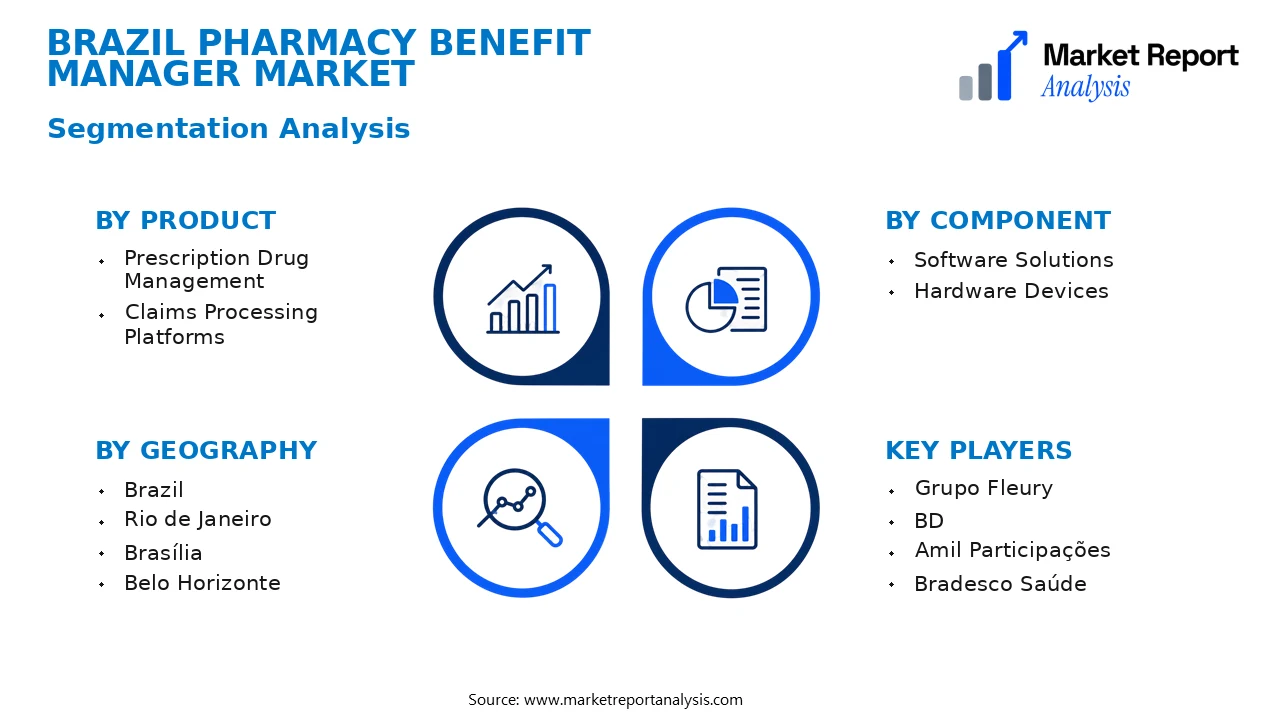
- Product
- Prescription Drug Management: Encompasses systems and services focused on managing prescription drug benefits, optimizing medication therapies, and controlling costs, which are crucial for health plan administrators and pharmaceutical companies.
- Claims Processing Platforms: Software solutions designed to streamline claims adjudication, enhance accuracy, and reduce processing time, supporting health insurers and PBMs in operational efficiency and compliance.
- Component
- Software Solutions: Comprise cloud-based and on-premise software integral to pharmacy benefit management, facilitating patient data management, formulary management, and reporting functionalities vital for PBMs.
- Hardware Devices: Includes servers, networking equipment, and other physical infrastructure that support the deployment and operation of PBM software solutions, ensuring system reliability and security.
- Geography
- Brazil: The national market encompasses diverse healthcare markets across Brazil, with significant opportunities driven by public and private healthcare sector growth, regulatory reforms, and increasing demand for efficient PBM services.
- São Paulo: As Brazil’s financial and corporate hub, São Paulo hosts a large concentration of PBMs, healthcare providers, and pharmaceutical companies, making it a critical market for PBM technology adoption.
- Rio de Janeiro: Known for its vibrant healthcare infrastructure and large population, Rio de Janeiro offers substantial market opportunities, especially in urban health management and pharmaceutical services.
- Brasília: The political capital with a significant presence of government health agencies, Brasília plays a strategic role in facilitating policy-driven adoption of PBM solutions.
- Belo Horizonte: A regional healthcare and business hub with growing pharmaceutical and healthcare service sectors, contributing to regional PBM market expansion.
- Curitiba: Known for its innovative healthcare systems and technological adoption, Curitiba presents opportunities for advanced PBM platform deployment and digital health initiatives.
- Porto Alegre: With a focus on healthcare innovation and a sizeable urban population, Porto Alegre remains vital for regional PBM services and technological integration.
- Recife: As a major healthcare and commercial center in northern Brazil, Recife shows high demand for pharmacy benefit solutions tailored to regional healthcare challenges.
- Salvador: This coastal city’s expanding healthcare infrastructure supports a growing PBM market, especially in public health programs and private insurance schemes.
- Campinas: A technological and industrial hub with a strong presence of pharmaceutical firms, making it a strategic city for PBM technological adoption and partnerships.
- Fortaleza: Serving northern Brazil, Fortaleza’s healthcare sector growth supports increased PBM activity, particularly in regional health coverage and pharmaceutical services.
- Brazil: The national market encompasses diverse healthcare markets across Brazil, with significant opportunities driven by public and private healthcare sector growth, regulatory reforms, and increasing demand for efficient PBM services.
Competitive Intelligence
The Brazil Pharmacy Benefit Manager (PBM) market exhibits a concentrated competitive landscape dominated by a few key players, including both national and multinational corporations. These firms leverage strategic mergers, acquisitions, and partnerships to expand their geographic footprint across major cities such as São Paulo, Rio de Janeiro, and Brasilia, optimizing distribution channels and enhancing service offerings. Innovation is central to their competitiveness, with ongoing R&D investments aimed at developing advanced data analytics, personalized medication management programs, and digital health solutions to differentiate their portfolios. Business strategies primarily focus on forming collaborations with healthcare providers and pharmaceutical companies to streamline drug procurement and reduce costs, while also expanding pharmacy networks to improve patient access. Notably, some competitors are investing heavily in AI-driven predictive analytics to personalize benefit plans and improve efficiency, gaining a competitive edge. Market players are also pursuing regional expansion strategies to penetrate underserved areas, further consolidating their market positions and creating barriers to entry for new entrants.
Leading Company Profiles
The competitive landscape of the Brazil Pharmacy Benefit Manager (PBM) Market is characterized by the presence of several key players, each leveraging advanced technology, strategic alliances, and innovative service offerings to gain a competitive edge. These companies are focusing on expanding their service portfolios, integrating digital health solutions, and enhancing operational efficiencies to meet the evolving needs of healthcare payers and providers in Brazil.
- Grupo Fleury
- BD
- Amil Participações
- Bradesco Saúde
- SulAmérica Saúde
- NotreDame Intermédica
- Qualicorp
- Porto Seguro Saúde
- Hapvida Saúde
- Prevent Senior
Grupo Fleury
Grupo Fleury specializes in healthcare diagnostics and comprehensive health management services, harnessing technological innovation and data analytics to optimize pharmacy benefits and improve patient care outcomes throughout Brazil.
BD
BD offers healthcare technology solutions focusing on drug delivery, data management, and digital health platforms, demonstrating strong strengths in integrated PBM solutions and strategic partnerships for enhancing clinical and administrative efficiencies.
Amil Participações
Amil provides health insurance and PBM services, with a focus on digital transformation, customer-centric offerings, and expanding its technological capabilities to manage complex pharmacy benefit programs efficiently in the Brazilian market.
Bradesco Saúde
As a major health insurance provider, Bradesco Saúde integrates advanced digital platforms and data-driven strategies to streamline pharmacy benefit management and improve access and affordability for its extensive client base across Brazil.
SulAmérica Saúde
SulAmérica Saúde emphasizes innovative healthcare solutions, leveraging data analytics and telehealth integration to enhance pharmacy benefit management and support proactive healthcare decision-making in Brazil.
NotreDame Intermédica
NotreDame Intermédica specializes in health plans and PBM services with a focus on vertical integration, leveraging technology to optimize medication management, reduce costs, and improve health outcomes for its members.
Qualicorp
Qualicorp operates as a leading administrator for collective health plans, offering tailored PBM services with advanced digital platforms and analytics, aimed at streamlining pharmacy benefit delivery across a broad client base across Brazil.
Porto Seguro Saúde
Porto Seguro Saúde focuses on innovative digital solutions, enhancing its pharmacy benefit management through technology-driven initiatives aimed at improving efficiency, reducing costs, and expanding access to healthcare services.
Hapvida Saúde
Hapvida leverages extensive scale and technology to optimize pharmacy benefits, with a focus on integrated health service delivery, digital health innovations, and expanding its regional footprint within Brazil’s healthcare landscape.
Prevent Senior
Prevent Senior emphasizes innovative healthcare services with a digital-first approach, focusing on chronic disease management, medication adherence, and patient engagement strategies within its pharmacy benefit programs.
Strategic Business Developments
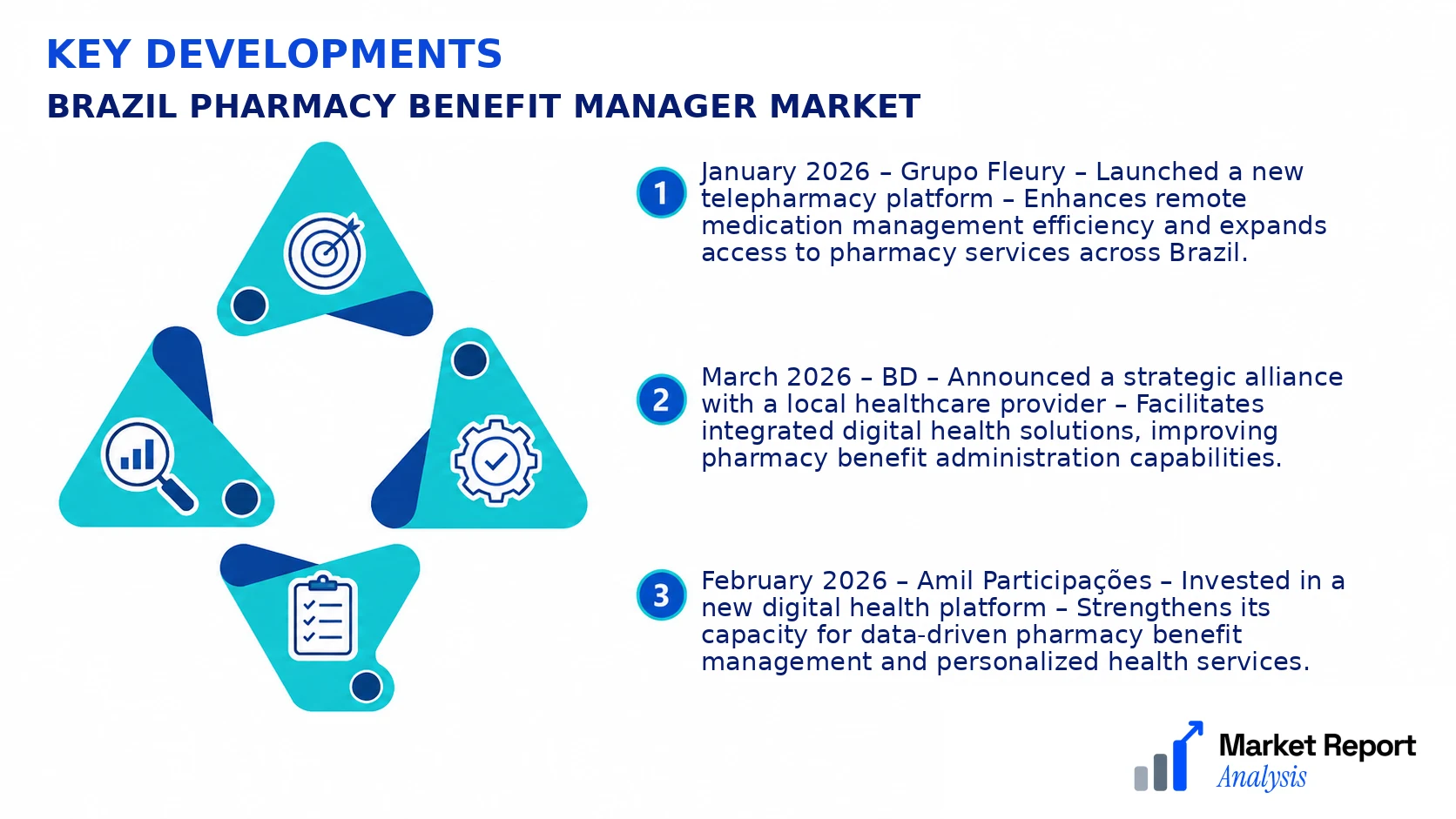
- January 2026 – Grupo Fleury – Launched a new telepharmacy platform – Enhances remote medication management efficiency and expands access to pharmacy services across Brazil.
- March 2026 – BD – Announced a strategic alliance with a local healthcare provider – Facilitates integrated digital health solutions, improving pharmacy benefit administration capabilities.
- February 2026 – Amil Participações – Invested in a new digital health platform – Strengthens its capacity for data-driven pharmacy benefit management and personalized health services.
- April 2026 – Bradesco Saúde – Expanded its pharmacy network through key acquisitions – Boosts network coverage and enhances service delivery for its members.
- May 2026 – SulAmérica Saúde – Launched a new health analytics tool – Supports predictive medicine and proactive pharmacy benefit cost management, improving health outcomes and reducing expenditures.
Frequently Asked Questions
What is the Brazil Pharmacy Benefit Manager Market?
The Brazil Pharmacy Benefit Manager (PBM) Market comprises companies that administer prescription drug plans, negotiate with pharmacies and drug manufacturers, and manage formularies to optimize medication use and control costs across Brazil's healthcare system. It facilitates efficient drug distribution and reimbursement processes.
What is the current market size of Brazil Pharmacy Benefit Manager Market?
As of 2026, the Brazil PBM Market is valued at approximately USD 2.4 Billion, reflecting increasing investment in healthcare infrastructure, rising demand for managed pharmacy services, and evolving regulatory frameworks that favor consolidated drug management solutions for insurers and healthcare providers.
What factors are driving the Brazil Pharmacy Benefit Manager Market?
Market growth is propelled by expanding healthcare coverage, the need for cost containment in public and private sectors, increased adoption of digital health platforms, regulatory support for integrated healthcare solutions, and rising prevalence of chronic diseases requiring managed medication strategies.
Which region dominates the Brazil Pharmacy Benefit Manager Market?
Southeast Brazil leads the market, driven by its dense population, high healthcare expenditure, and concentration of healthcare institutions and insurers, making it the primary hub for PBM services and innovative pharmaceutical management practices.
Which segment is expected to grow the fastest?
The digital and telepharmacy segment is anticipated to witness the fastest CAGR, owing to technological advancements, increased telehealth adoption, and digital health record integration, which streamline pharmacy benefit management and enhance patient engagement.
Who are the leading companies operating in the Brazil Pharmacy Benefit Manager Market?
Key players include Amil, UnitedHealth Group, and CarePlus, alongside regional providers like Drogaria São Paulo and private insurers collaborating with global PBMs to expand their market presence and innovate service offerings for better drug management.
Analyst Perspective
The Brazil Pharmacy Benefit Manager (PBM) market exhibits a mature yet evolving landscape, with significant long-term growth potential driven by expanding healthcare coverage and increasing pharmaceutical expenditures. Attractive opportunities are concentrated in digital health integrations, data analytics, and targeted formulary management, which can enhance efficiency and patient outcomes. Technological evolution is set to accelerate, with innovative solutions such as AI-driven decision support and blockchain-based claims processing gaining prominence, fostering a more transparent and streamlined PBM ecosystem.
Investment priorities should focus on regional expansion into underserved areas like the North and Northeast, leveraging Brazil’s growing urban centers such as São Paulo and Rio de Janeiro as strategic hubs. Competitive intensity remains high, demanding differentiation through technological advancement and customer service excellence. Over the long term, regional growth potential will be amplified by government reforms and increasing private sector involvement. Carefully navigating regulatory shifts and regional disparities will be critical for sustained success, positioning market players to capitalize on emerging trends and distribution channels in Brazil’s dynamic healthcare environment.
