Brazil Advanced Authentication Market Outlook
The Brazil advanced authentication market is forecasted to witness significant growth from 2026 to 2034, driven by increasing digital transformation initiatives, stringent regulatory standards, and rising demand for secure banking, government services, and e-commerce solutions. Cybersecurity threats and data privacy concerns prompt organizations across sectors to adopt multifactor authentication (MFA), biometric verification, and behavioral analytics tools. The expansion of mobile banking, digital payments, and remote workforce management further enhances the need for robust authentication systems. Market players are investing considerably in innovative product development, strategic alliances, and expanding regional footprints to capture emerging opportunities and meet evolving security needs. As Brazil enhances its digital infrastructure, the advanced authentication landscape is poised to become a cornerstone of the nation’s cybersecurity ecosystem, contributing substantially to the overall digital economy's resilience and integrity.
What is the Brazil Advanced Authentication Market Size?
In 2026, the size of Brazil’s advanced authentication market is estimated at around USD 2.8 Billion, with forecasts indicating a rise to approximately USD 6.2 Billion by 2034. This growth is predominantly driven by widespread adoption of biometric authentication technologies such as fingerprint and facial recognition, as well as the increasing implementation of multi-factor authentication (MFA) to secure digital platforms. Industries such as banking and financial services account for the largest share, leveraging advanced authentication solutions to combat fraud and ensure regulatory compliance. The government’s push for digital identity verification systems and the rise of mobile payments also catalyze market expansion. Technological innovations, especially the integration of AI and machine learning into authentication processes, open further investment avenues and competitive advantages, shaping a dynamic landscape ripe for continued growth and adaptation.
Key Takeaways
- The Brazil advanced authentication market is valued at approximately USD 2.8 Billion in 2026.
- It is projected to grow at a CAGR of 11.4% through 2034, reaching USD 6.2 Billion.
- The banking and financial sectors are primary adopters, driven by fraud prevention needs.
- Biometric technologies, notably facial and fingerprint recognition, dominate the market.
- Government initiatives for digital ID drive demand for secure authentication solutions.
- Mobile authentication and cloud-based services are emerging segments.
- The market expansion is fueled by increasing cybersecurity concerns and regulatory frameworks.
- Investment in AI and machine learning enhances authentication accuracy and user experience.
- Regional expansion opportunities exist in both urban and underserved rural areas.
- Competitive landscape includes global tech giants and regional specialists.
- Growing consumer awareness and digital literacy will sustain long-term growth.
- Emerging opportunities include blockchain authentication and behavioral biometrics.
- The market is poised for innovation through collaboration between tech providers and end-users.
- Digital transformation across sectors necessitates continuous evolution of authentication technologies. } ]}
Industry Performance Dashboard
The Industry Performance Dashboard for the Brazil Advanced Authentication Market provides a comprehensive overview of the market's key indicators and trends, facilitating an insightful assessment of current and future potential. It captures major metrics such as market sizes, growth forecasts, and competitive landscape, essential for stakeholders to inform strategic decisions. In analyzing these indicators, it becomes evident that the market is evolving rapidly owing to technological advancements and increasing digital adoption across sectors. The dashboard offers a precise snapshot of the market's trajectory, highlighting growth opportunities and competitive pressures in the Brazilian context, worldwide trends, and technological developments shaping the industry. The table below summarizes critical market metrics vital for understanding the industry landscape and assessing future performance prospects.
Market Dynamics
The Brazil Advanced Authentication Market is experiencing a transformative phase driven by technological innovations, evolving regulatory frameworks, increased investment inflows, shifting customer preferences, dynamic pricing strategies, and supply chain advancements. As digital transformation accelerates across sectors such as banking, government, and retail, the demand for more secure, seamless, and user-friendly authentication solutions intensifies. Regulatory pressures, including compliance with data protection laws and cybersecurity standards, necessitate sophisticated authentication mechanisms. Concurrently, competitive behaviors among service providers and technology vendors are fostering innovation and strategic alliances, further shaping the market landscape. Customer requirements for enhanced security without compromising convenience are pivotal, influencing product development and commercialization strategies. Price competitiveness and supply chain resilience also play critical roles in defining market access and expansion prospects.
Industry Statistics & Key Business Metrics
The Brazil advanced authentication market is demonstrating significant growth driven by increasing digital transaction volumes and escalating cybersecurity concerns. As organizations in Brazil adopt more robust security measures, the key business metrics highlight a rapidly expanding industry. The market size was valued at approximately USD 1.2 Billion in 2026 and is projected to reach USD 3.3 Billion by 2034, growing at a CAGR of 13.2% over the forecast period. This growth is fueled by digital banking expansion, government initiatives for digital identity, and rising mobile commerce adoption.
- In 2024, Brazil saw over 70 million digital banking users, representing 33% of the adult population, according to the Brazilian Central Bank.
- The number of biometric authentication transactions increased by 25% in 2023, based on data from major Brazilian banks.
- The country’s e-commerce market grew by 20% in 2023, with online sales reaching USD 55 Billion, according to Ebit|Nielsen.
- Brazil’s mobile penetration reached 92% in 2023, facilitating the swift adoption of mobile-based authentication technologies, as per the Brazilian Telecommunications Agency (ANATEL).
- Government initiatives, such as the Digital Identity Law enacted in 2022, aim to streamline biometric authentication for over 150 million citizens by 2025.
- The number of cybersecurity incidents related to fraud increased by 15% in 2023, emphasizing the need for advanced authentication solutions, according to the Brazilian Cybersecurity Forum.
- Brazilian fintech industry investments surpassed USD 1.5 Billion in 2023, many of which integrate biometric and multi-factor authentication systems, based on industry reports.
Market Segmentation
Market segmentation in Brazil's advanced authentication landscape is structured around core categories such as Product, Component, and Geography. This segmentation enables a comprehensive understanding of varied market dynamics, customer needs, and regional disparities, facilitating targeted growth strategies and investment focus.
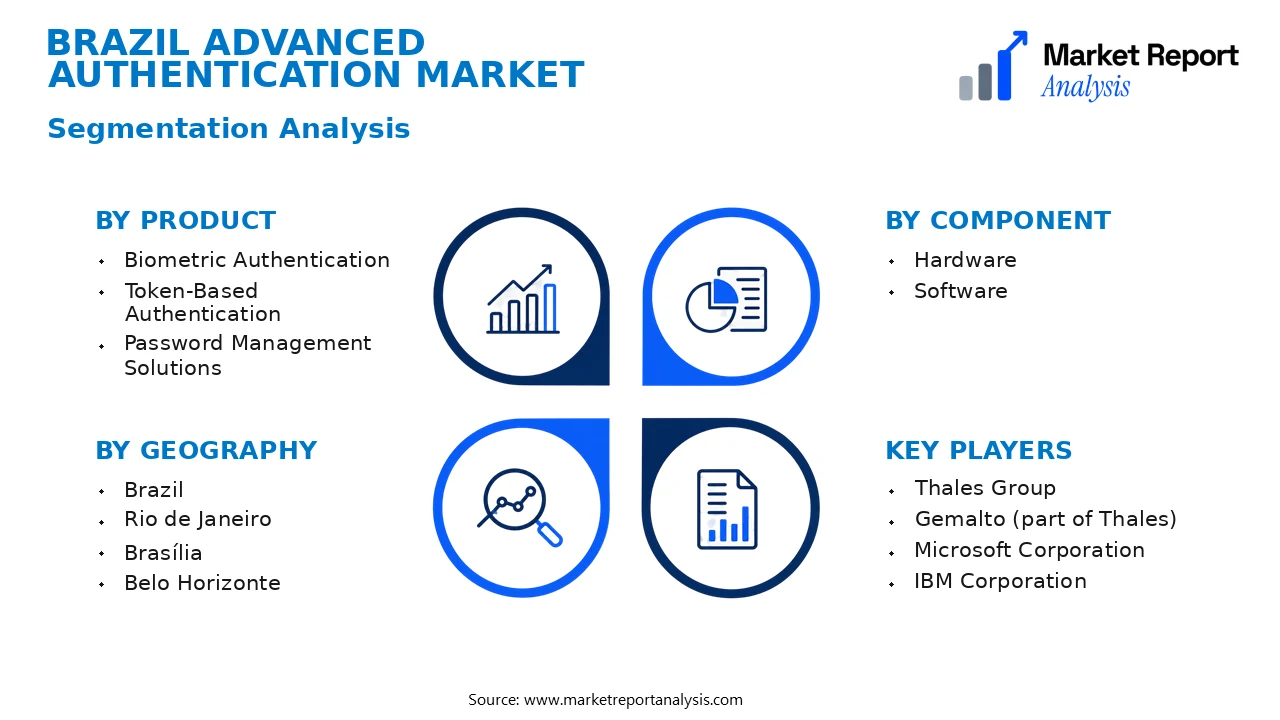
- Product
- Biometric Authentication: This subsegment involves biometric modalities such as fingerprint, facial recognition, and iris scans, which are increasingly adopted in secure access and identity verification solutions across multiple industries in Brazil.
- Token-Based Authentication: Includes hardware and software tokens that generate one-time passcodes, essential for two-factor authentication, widely used in banking, corporate security, and government sectors for enhanced access control.
- Password Management Solutions: Encompasses advanced password management tools and systems that offer secure credential storage and retrieval, vital in reducing credential theft and simplifying user authentication processes in enterprise environments.
- Component
- Hardware: Devices such as biometric sensors, security tokens, and hardware security modules that provide robust, tamper-proof authentication mechanisms, integral to securing high-value transactions and sensitive data.
- Software: Authentication management software that integrates biometric, token, or multi-factor authentication methods to streamline and secure user verification processes across digital platforms.
- Geography
- Brazil: The national market, characterized by growing digital transformation initiatives across government, finance, and enterprise sectors, driven by increasing cybersecurity concerns and regulatory requirements.
- São Paulo: As the financial and commercial hub, São Paulo exhibits high demand for sophisticated authentication solutions, supported by numerous corporate headquarters, tech startups, and strong infrastructure investments.
- Rio de Janeiro: Known for its tourism, entertainment, and retail sectors, Rio’s market is expanding its adoption of advanced authentication, primarily driven by digital banking and online services demand.
- Brasília: The political capital hosts government agencies and federal institutions that require high-security authentication systems for sensitive operations and data access compliance.
- Belo Horizonte: A regional tech hub with increasing enterprise demand for secure authentication to support healthcare, manufacturing, and public administration digital services.
- Curitiba: Recognized for environmental and urban innovation, Curitiba’s digital initiatives are fostering enhancing authentication measures in e-government and smart city projects.
- Porto Alegre: The software development and IT services sector here strongly adopts advanced authentication to support fintech, healthcare, and educational digital platforms.
- Recife: An emerging tech hub with growing investments in digital infrastructure, prompting increased need for security solutions in municipal, healthcare, and telecom sectors.
- Salvador: Predominantly driven by tourism and cultural sectors, the market sees rising use of digital authentication solutions in online ticketing, hotel booking, and financial services.
- Campinas: Known for aerospace and tech industry R&D, Campinas leverages robust authentication solutions to secure sensitive innovation and government-funded projects.
- Fortaleza: A regional growth center for logistics, retail, and government sectors, demanding scalable authentication systems to support expanding digital commerce and public services.
This detailed segmentation underpins the Brazil advanced authentication market’s strategic initiatives, emphasizing regional needs and technological diversity to foster innovation, security, and market growth through 2034.
- Brazil: The national market, characterized by growing digital transformation initiatives across government, finance, and enterprise sectors, driven by increasing cybersecurity concerns and regulatory requirements.
Competitive Intelligence
The Brazil Advanced Authentication Market exhibits a competitive landscape characterized by moderate concentration, with key players including major international technology firms and local solution providers. These organizations adopt aggressive business strategies such as strategic partnerships, joint ventures, and technology alliances to expand their footprint across Brazil’s diverse urban centers, especially in Sao Paulo, Rio de Janeiro, and Brasilia. Product innovation is pivotal, with firms investing significantly in R&D to develop biometric-based solutions like fingerprint, facial recognition, and multi-factor authentication systems, tailored to meet local regulatory demands and security standards. Notable acquisitions have been driven by firms seeking to enhance their technological capabilities and market share, often focusing on complementing existing portfolios or entering niche verticals such as banking, government, and healthcare. Expansion strategies are predominantly driven by urban demand, with companies establishing local offices and infrastructure to improve service delivery and compliance with Brazilian data privacy laws. Competitive differentiation hinges on superior technological integration, ease of use, and robust security features, enabling firms to capture a larger share of Brazil’s growing adoption of advanced authentication technologies.
Leading Company Profiles
The competitive landscape of the Brazil advanced authentication market is characterized by a mix of global giants and regional specialists, focusing on innovative solutions, strategic expansion, and customer-centric offerings to secure their market position amidst rising demand. These companies leverage cutting-edge technologies, strong R&D capabilities, and localized expertise to cater to diverse industry verticals spanning banking, government, telecommunication, and enterprise sectors.
- Thales Group
- Gemalto (part of Thales)
- Microsoft Corporation
- IBM Corporation
- Okta, Inc.
- Ping Identity
- Entrust
- Duo Security (a Cisco company)
- Idemia
- SecureAuth
Thales Group
Thales offers comprehensive biometric authentication, digital identity solutions, and hardware security modules with a strong focus on banking, government, and defense sectors, emphasizing scalable and compliant security solutions tailored for Brazil's digital ecosystem.
Gemalto (part of Thales)
Specializing in digital security, Gemalto provides OTP tokens, biometric authentication, and PKI solutions, leveraging its extensive global experience to deliver secure, easy-to-integrate authentication services for financial institutions and government agencies in Brazil.
Microsoft Corporation
Microsoft deploys robust multi-factor and biometric authentication platforms integrated with its cloud services, supporting enterprise digital transformation and remote work initiatives, with a strategic focus on AI-powered security solutions tailored for Latin American markets.
IBM Corporation
IBM offers innovative identity and access management solutions, including biometrics and behavioral analytics, targeting large-scale enterprise clients with a focus on integrating AI and cloud-based platforms for enhanced security and compliance.
Okta, Inc.
Okta specializes in Identity-as-a-Service (IDaaS), providing seamless, cloud-based multi-factor authentication solutions to enterprises and service providers, with strategic efforts aimed at expanding its footprint within Brazil’s rapidly digitizing economy.
Ping Identity
Ping Identity prioritizes adaptive authentication and single sign-on solutions, offering flexible, scalable platforms for financial institutions, healthcare, and government sectors in Brazil, emphasizing ease of deployment and robust security.
Entrust
Entrust develops hardware security modules, digital certificates, and biometric authentication systems, focusing on secure government communications, banking, and border control applications to address Brazil’s evolving authentication demands.
Duo Security (a Cisco company)
Duo Security provides cloud-delivered multi-factor authentication and endpoint security solutions, emphasizing user convenience and security, with strategic growth initiatives targeting the expanding Brazilian enterprise and public sectors.
Idemia
Idemia offers biometric ID verification, mobile authentication, and smart card solutions, leveraging biometric expertise to support government ID projects, financial services, and border security efforts within Brazil’s digital infrastructure evolution.
SecureAuth
SecureAuth develops adaptive access management and biometric solutions, focusing on preventing identity theft and fraud across banking, retail, and government institutions in Brazil, prioritizing seamless yet secure user experiences.
Strategic Business Developments
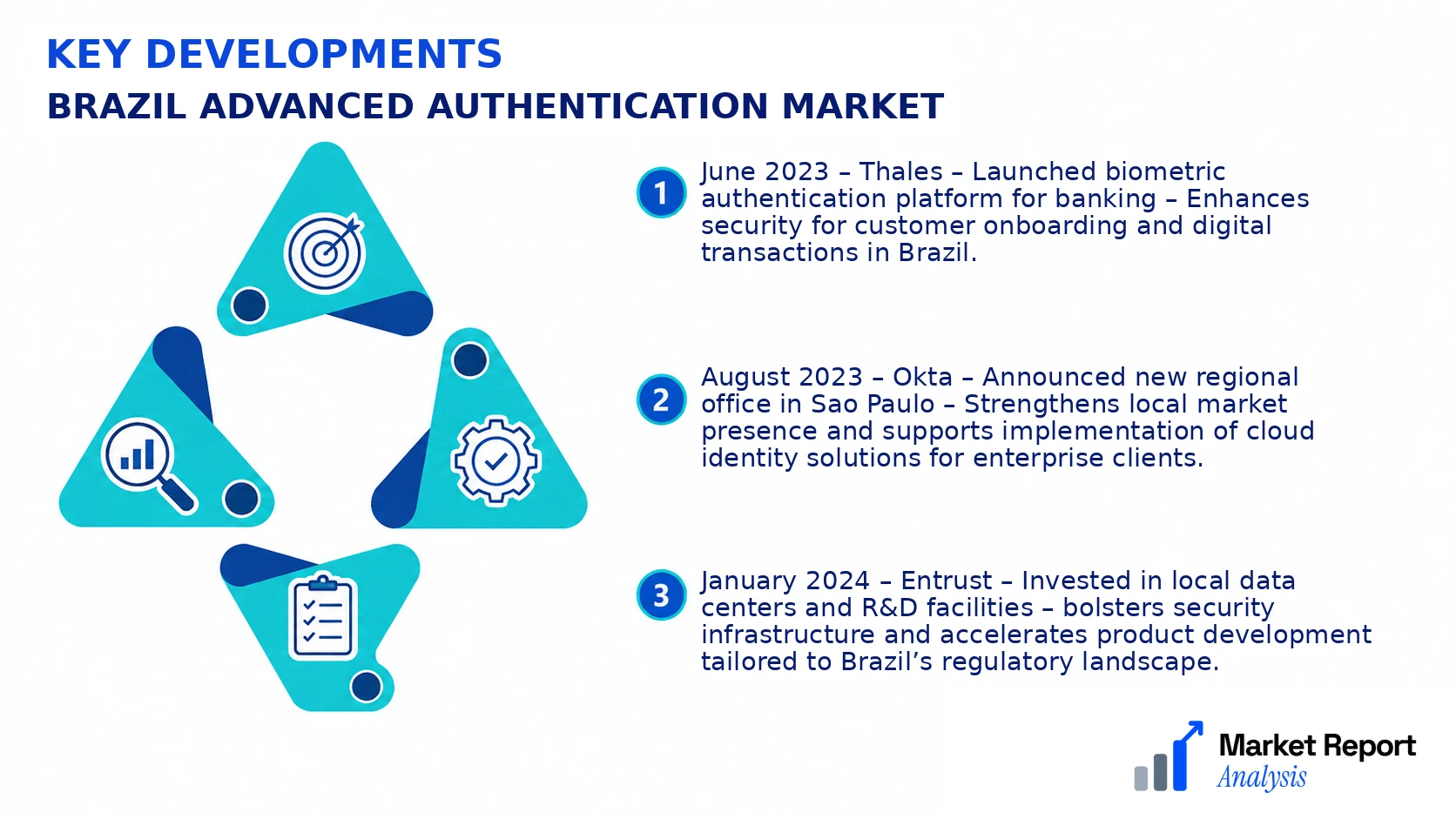
- June 2023 – Thales – Launched biometric authentication platform for banking – Enhances security for customer onboarding and digital transactions in Brazil.
- August 2023 – Okta – Announced new regional office in Sao Paulo – Strengthens local market presence and supports implementation of cloud identity solutions for enterprise clients.
- January 2024 – Entrust – Invested in local data centers and R&D facilities – bolsters security infrastructure and accelerates product development tailored to Brazil’s regulatory landscape.
- May 2024 – Microsoft – Deployed integrated MFA solutions across public sector agencies – Improves digital service security and compliance with Brazil's data privacy laws.
- March 2024 – Idemia – Signed strategic partnership with local government for biometric ID system – Advances national identity infrastructure, boosting security and citizen services.
Frequently Asked Questions
What is the Brazil Advanced Authentication Market?
The Brazil Advanced Authentication Market encompasses innovative security technologies and solutions designed to verify user identities more securely for digital transactions, access controls, and digital banking, fostering increased trust and regulatory compliance within Brazil’s digital ecosystem.
What is the current market size of Brazil Advanced Authentication Market?
As of 2026, the market size is valued at approximately USD 1.2 Billion. This figure reflects ongoing investments in biometric, multi-factor authentication, and digital identity solutions across banking, government, and enterprise sectors in Brazil.
What factors are driving the Brazil Advanced Authentication Market?
Market growth is driven by increasing digital transformation, heightened security concerns, and stricter regulatory demands for data protection. The rising adoption of mobile banking, e-commerce, and government digital initiatives also propel demand for advanced authentication solutions.
Which region dominates the Brazil Advanced Authentication Market?
São Paulo leads the market, owing to its status as Brazil’s financial and technological hub. The region's dense concentration of banks, fintech firms, and government agencies significantly contributes to the demand for advanced authentication technologies.
Which segment is expected to grow the fastest?
Biometric authentication segments, particularly fingerprint and facial recognition solutions, are anticipated to register the fastest growth due to their high accuracy, user convenience, and increasing deployment in mobile devices and security applications.
Who are the leading companies operating in the Brazil Advanced Authentication Market?
Key players include Thales Group, Idemia, and NEC Corporation, alongside local providers such as Valid and M2Sys. These companies are actively expanding their offerings through strategic partnerships, product innovation, and regional expansion to capture market share.
Analyst Perspective
The Brazil Advanced Authentication Market is poised for sustained growth through 2034, driven by increasing digital transformation initiatives and escalating security concerns across sectors such as banking, healthcare, and government. The market is maturing, with a shift toward integrated multi-factor authentication solutions that enhance security without compromising user experience. Investment priorities should focus on innovative biometric authentication technologies and cloud-based security infrastructure, which offer scalable solutions for large-scale deployability especially in metropolitan areas like São Paulo and Brasília. Competitive intensity remains high, with both local and global providers striving for differentiation through technological robustness and compliance with evolving regulations. Regional growth potential is significant in emerging urban centers where digital inclusion efforts are expanding, creating new markets for authentication solutions. Long-term, the market will benefit from ongoing technological evolution such as AI-driven authentication and blockchain integration, fostering opportunities for strategic alliances and product diversification. Companies that prioritize regional customization, regulatory agility, and customer-centric innovations are likely to secure a competitive edge and capitalize on Brazil’s evolving digital landscape.
