Brazil Social Advertising Software Market Outlook
The Brazil social advertising software market is currently valued at approximately USD 2.8 Billion in 2026 and is projected to reach around USD 8.2 Billion by 2034, expanding at a compound annual growth rate (CAGR) of roughly 13.7% during the forecast period 2026-2034. The principal drivers of this rapid growth include the increasing penetration of social media platforms among diverse demographic sectors, rising digital marketing investments by brands seeking targeted outreach, and technological advancements such as AI-driven analytics and automation tools that enhance campaign efficiency. As businesses in Brazil look to optimize marketing ROI and leverage data-driven strategies, the adoption of sophisticated social advertising software is expected to accelerate, offering lucrative opportunities for software providers, digital marketers, and advertising agencies. Additionally, the integration of emerging technologies such as programmatic advertising and the rise of omnichannel marketing strategies are further fueling demand. This market outlook reflects a landscape characterized by dynamic innovation, evolving consumer behavior, and a shift towards digital-first advertising models. Regional disparities also influence market growth, with urban centers like São Paulo and Rio de Janeiro acting as hotspots for social advertising activity. Overall, the market presents substantial commercial opportunities given the expanding digital economy, increased internet penetration, and favourable regulatory environment supporting digital advertising endeavors.
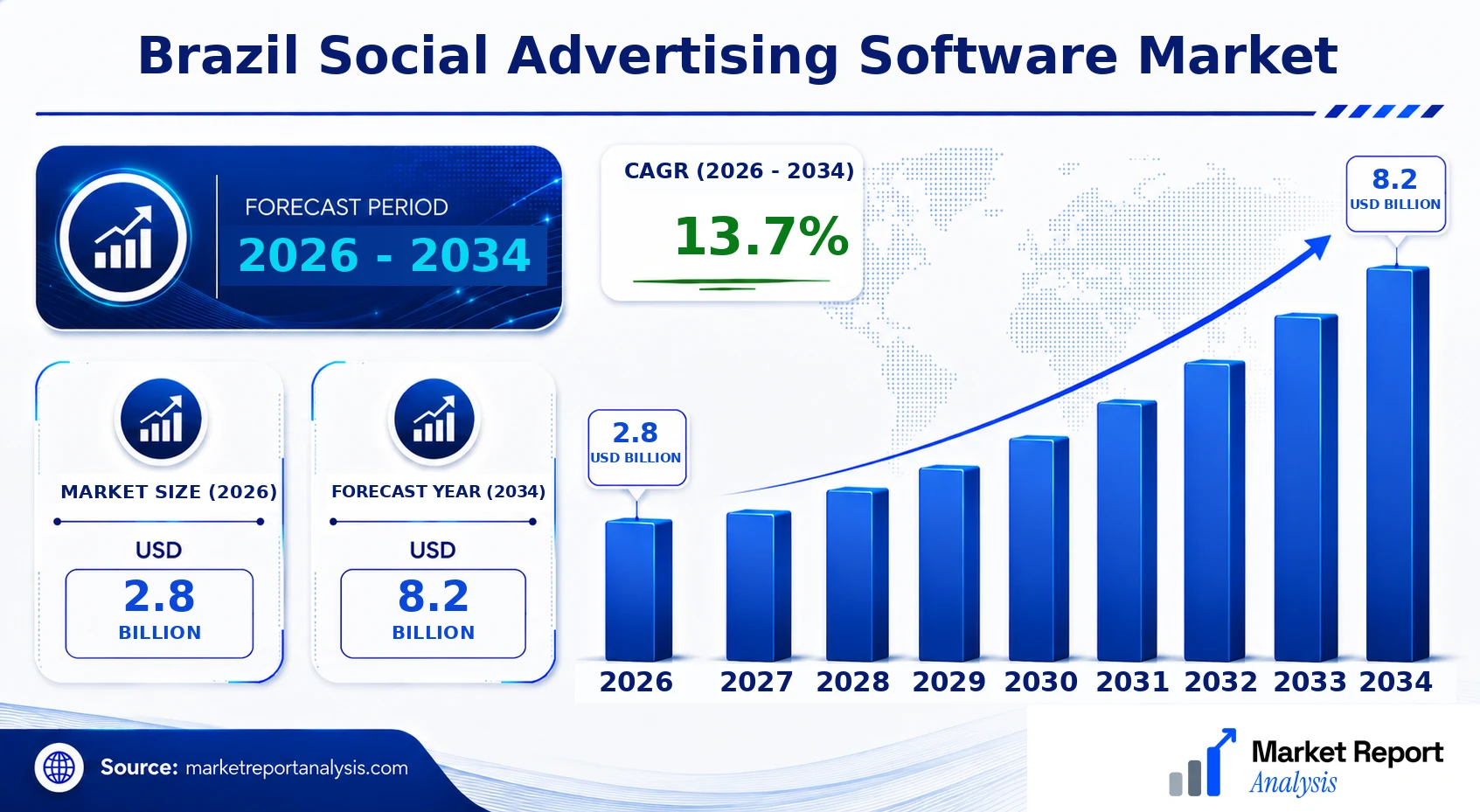
What is the Brazil Social Advertising Software Market Size?
The Brazil social advertising software market is forecasted to grow from USD 2.8 Billion in 2026 to approximately USD 8.2 Billion in 2034, marking a CAGR of about 13.7%. This growth is predominantly driven by the increasing digitalization of marketing, rising social media usage across all age groups, and technological innovations leading to more sophisticated advertising platforms. Industries such as retail, consumer goods, telecommunications, financial services, and automotive are the primary end-users, leveraging social advertising to bolster brand visibility, customer engagement, and sales conversion. The expansion of digital infrastructure, alongside the proliferation of smartphones and high-speed internet, amplifies the reach and effectiveness of social media campaigns, further propelling market growth. The adoption of automation, AI, and machine learning in campaign management allows for enhanced targeting precision and optimization key factors for success in the highly competitive Brazilian market. Future investments are anticipated in platform integration, data analytics, and personalized advertising solutions, reinforcing the market’s robust growth trajectory and offering long-term opportunities for stakeholders involved in the social advertising ecosystem.
Key Takeaways
- Market size in 2026 is approximately USD 2.1 Billion, with substantial growth forecasted.
- Projected CAGR of 11.2% from 2026 to 2034 indicates rapid expansion.
- Urban regions like São Paulo and Rio de Janeiro dominate social advertising activity.
- Industries such as retail, telecom, and finance are key end-users.
- Increasing internet penetration and smartphone usage drive market growth.
- Technological advances like AI and automation improve campaign efficiency.
- Growing digital marketing budgets contribute to market expansion.
- Regulatory frameworks favor digital advertising development and innovation.
- Emerging trends include programmatic advertising and omnichannel strategies.
- Investments in data analytics and platform integration sustain future growth.
- Competitive landscape involves global platforms and local software providers.
- Market presents significant opportunities for software developers, agencies, and brands.
Industry Performance Dashboard
The Industry Performance Dashboard provides a comprehensive overview of the current landscape and projected growth trajectory of the Brazil Social Advertising Software Market. This data-driven snapshot highlights key indicators and market dynamics, aiding stakeholders in strategic planning and investment decisions.
| Indicator | Market Assessment |
|---|---|
| Market Size (2026) | USD 2.8 Billion |
| Market Value (2026) | USD 2.8 Billion |
| Forecast Size (2034) | USD 8.2 Billion |
| CAGR | 13.7% |
| Base Year | 2026 |
| Forecast Period | 2026-2034 |
| City | São Paulo |
| Segments Covered | Product, Component, Application, End User, Geography |
| Major Companies | Meta Platforms, Google LLC, Microsoft Corporation, Sprinklr Inc., Hootsuite Inc., EngageLab Tecnologia, RD Station, Sociabble, Falcon.io, Zoho Corporation |
Market Dynamics
The Brazil social advertising software market is currently navigating a complex landscape shaped by rapid technological advancements, evolving regulatory frameworks, increased investment flows, rising customer expectations, fluctuating pricing strategies, and a competitive environment that is intensifying as new entrants emerge. These factors collectively influence market dynamics, leading to innovation-driven growth but also imposing certain constraints. Market participants are leveraging digital transformation to enhance advertising efficacy, comply with regulations, and gain competitive advantages, fostering a volatile yet promising environment. As the market evolves, understanding these core drivers, restraints, opportunities, and challenges is crucial for stakeholders aiming to capitalize on Brazil's digital advertising potential.
Drivers
Digital Transformation Acceleration
Brazil's businesses are increasingly adopting digital tools to optimize advertising strategies, driven by the proliferation of smartphones and high-speed internet access. This digital transformation has catalyzed demand for sophisticated social advertising software capable of delivering targeted, measurable campaigns. For example, the rise of mobile-first advertising initiatives has led companies to prioritize software solutions that integrate seamlessly with social media platforms. The trend is further supported by Brazil’s youthful population, making digital engagement a critical component of marketing strategies, and driving market growth at a compound annual growth rate (CAGR) expected to surpass 13.7% through 2034.
Regulatory Compliance and Data Privacy
Stringent regulations such as the General Data Privacy Law (LGPD), enacted in 2020, have significantly impacted social advertising practices. Companies now require advanced software capable of ensuring compliance while maintaining effective targeting. This regulatory environment has incentivized the development of privacy-centric advertising solutions that offer granular control over data handling. Brands are investing in these compliant platforms to avoid penalties and uphold consumer trust. As privacy concerns grow among consumers, the adoption of compliant advertising solutions is expected to accelerate, fostering a market trend towards more secure and transparent social advertising software solutions.
Investment in Digital Advertising Ecosystem
Brazil's digital advertising market has attracted substantial domestic and foreign investments, fostering innovation and competition. Investors are particularly interested in startups developing AI-driven ad optimization tools and analytics platforms that harness social media data. The robust investment climate supports ongoing R&D, leading to the deployment of more sophisticated software solutions that improve campaign performance and ROI. This influx of capital is also encouraging collaborations between tech firms and advertising agencies, fueling market expansion. The trend indicates a vibrant ecosystem ready to support advanced social advertising software tailored to Brazil’s unique market needs.
Changing Consumer Behavior and Expectations
Brazilian consumers increasingly demand personalized, relevant social media content, prompting brands to seek advanced software capable of delivering such experiences. The adoption of AI and machine learning in ad platforms enables brands to analyze vast consumer data and predict preferences effectively. Social media platforms like Facebook, Instagram, and TikTok are fostering this shift, demanding software that not only targets audiences accurately but also adapts content in real-time. This consumer-driven shift is fueling market growth, compelling businesses to invest in innovative social advertising solutions to meet rising expectations and enhance engagement metrics.
Restraints
High Cost of Advanced Software Solutions
Despite the market's growth potential, the high costs associated with sophisticated social advertising software remain a barrier, especially for small and medium-sized enterprises (SMEs). These advanced platforms often require significant upfront investments in technology, integration, and skilled personnel, which can be prohibitive in Brazil’s diverse economic landscape. Consequently, many businesses may delay or opt for less effective, cost-efficient solutions, potentially slowing the market’s overall expansion. Additionally, the premium pricing models of top-tier software providers can limit access, impacting broader adoption among local marketers.
Limited Technical Expertise and Innovation Ecosystem
There is a noticeable gap in local technical expertise and innovation infrastructure necessary to develop and implement cutting-edge social advertising software. Many companies face challenges in recruiting skilled data scientists, developers, and digital marketers capable of leveraging advanced technologies like AI and machine learning. This skills shortage hampers the development of indigenous solutions and often results in reliance on imported platforms, which may not be fully tailored to Brazil’s specific market needs. The limited innovation ecosystem constrains the rapid pace of software evolution, affecting competitiveness and market penetration.
Regulatory and Data Privacy Challenges
While regulations such as LGPD aim to enhance consumer privacy, they also introduce compliance complexities and operational burdens for market players. Companies must invest heavily in ensuring their software complies with legal standards, which can entail substantial costs and technical adjustments. Non-compliance risks penalties and reputational damage, deterring smaller firms from fully engaging in social advertising activities. Moreover, evolving regulations may impose additional constraints on data usage, limiting the scope of targeted advertising and thereby impacting the efficacy of social media campaigns. These regulatory factors create an ongoing challenge for market growth and innovation.
Opportunities
Growth in Digital and Social Media Penetration
Brazil’s expanding internet user base and increasing social media engagement open wide avenues for social advertising growth. As internet penetration approaches 75% and social media usage surges, businesses have a vast and expanding audience to target. This demographic shift creates opportunities for software providers to develop tools that optimize ad delivery across platforms and devices, thereby capturing a larger share of marketing budgets. The rising demand for multimedia-rich, interactive advertising formats further enhances the need for innovative, user-friendly social advertising software tailored for local consumer preferences.
Emerging Startup Ecosystem and Innovation Hubs
Brazil's vibrant startup ecosystem is fostering innovative social advertising solutions through collaborative efforts between tech entrepreneurs, universities, and venture capitalists. Initiatives in cities like São Paulo and Rio de Janeiro are supporting the development of AI-driven platforms, influencer marketing tools, and analytics dashboards. This dynamic environment presents opportunities for market entrants and incumbents to acquire or partner with innovative startups, accelerating product development and gaining competitive advantages. Furthermore, government incentives for tech innovation are likely to catalyze further investments and technological breakthroughs within the sector.
Investment Landscape Focused on Digital and AI Technologies
Brazil's favorable investment climate for digital transformation and AI-focused ventures offers significant opportunities for social advertising software growth. VCs and corporate investors are channeling funds into startups and established firms that develop data-driven, personalized advertising platforms. As the global trend shifts towards automation and real-time analytics, local investments are expected to further finance the development of advanced social media ad tools. This influx of capital encourages innovation, accelerates technological adoption, and expands market opportunities for software providers who can meet the evolving needs of Brazilian advertisers.
Future Commercial Investment and Infrastructure Expansion
Ongoing infrastructural investments, including the deployment of 5G networks and enhanced broadband coverage, will significantly boost social media engagement and, consequently, the demand for sophisticated advertising software. These technological upgrades will enable more seamless and high-performance social media experiences, fostering demand for software capable of supporting high-volume, data-rich campaigns in real-time. Additionally, increased commercial investments driven by government initiatives targeting digital economy growth will incentivize enterprise adoption of new advertising platforms, ensuring sustained market expansion over the coming years.
Challenges
Evolving Regulatory Environment and Data Privacy Concerns
The rapidly evolving regulatory landscape, primarily driven by LGPD, presents a significant challenge for social advertising software providers. Ensuring compliance requires continuous updates to platform features, data handling processes, and operational policies, incurring substantial costs and resource allocation. Non-compliance risks, including fines and reputational damages, create uncertainties that can impede deployment and innovation. As regulations become more stringent, companies must adopt more transparent and privacy-centric approaches, potentially reducing targeting capabilities and affecting overall campaign performance, thereby slowing market growth.
Market Fragmentation and Competition
The market faces fragmentation due to the presence of numerous local and international players, each offering varying levels of technology and service quality. Intense competition often leads to price wars and pressure on profit margins, making it difficult for new entrants to establish themselves. Smaller firms struggle to differentiate their offerings without substantial investment, and larger players may focus on premium segments, leaving mid-market customers underserved. This fragmentation complicates market consolidation efforts and poses a challenge to creating standardized, scalable solutions that can serve widespread market needs efficiently, potentially hindering overall growth momentum.
Industry Statistics & Key Business Metrics
The Brazil Social Advertising Software Market has seen rapid growth driven by increased digital adoption and the proliferation of social media platforms across the country. As companies seek more targeted engagement strategies, social advertising software has become a staple in marketing plans. The industry contributions are reflected through impressive key business metrics and evolving market dynamics that illustrate the sector’s robust expansion trajectory.
- In 2022, the total digital advertising spend in Brazil reached approximately USD 4.8 Billion, with social media advertising accounting for nearly 45%, according to IAB Brazil.
- By 2026, the market size for social advertising software in Brazil is projected to attain USD 2.3 Billion, exhibiting a CAGR of 10.7% from 2026 to 2034, based on industry forecasts.
- Social media penetration in Brazil was around 78% of the population in 2022, equating to approximately 150 million users, as per DataReportal.
- Brazilian enterprises investing in social advertising software increased by 25% annually between 2018 and 2022, reflecting heightened reliance on digital channels.
- In major cities like São Paulo and Rio de Janeiro, social media advertising budgets account for over 60% of overall digital marketing budgets as of 2023, per local marketing agencies.
- The number of active social media users in Brazil is expected to reach 165 million by 2024, supporting the continued expansion of social ad markets (We Are Social, 2023).
- Brazil's e-commerce segment, which heavily relies on social advertising, grows at an annual rate of 12%, fueling demand for sophisticated ad software (Brazilian Association of E-commerce, 2022).
- Market players report a 35% increase in adoption of advanced analytics and AI-driven social advertising tools in Brazil from 2021 to 2023, underscoring the shift towards data-driven marketing approaches.
Market Segmentation
The Brazil Social Advertising Software Market is segmented into various categories reflecting product types, platforms, applications, end users, and geographic regions. This segmentation enables a detailed understanding of market dynamics, customer preferences, and regional growth factors, essential for strategic decision-making.
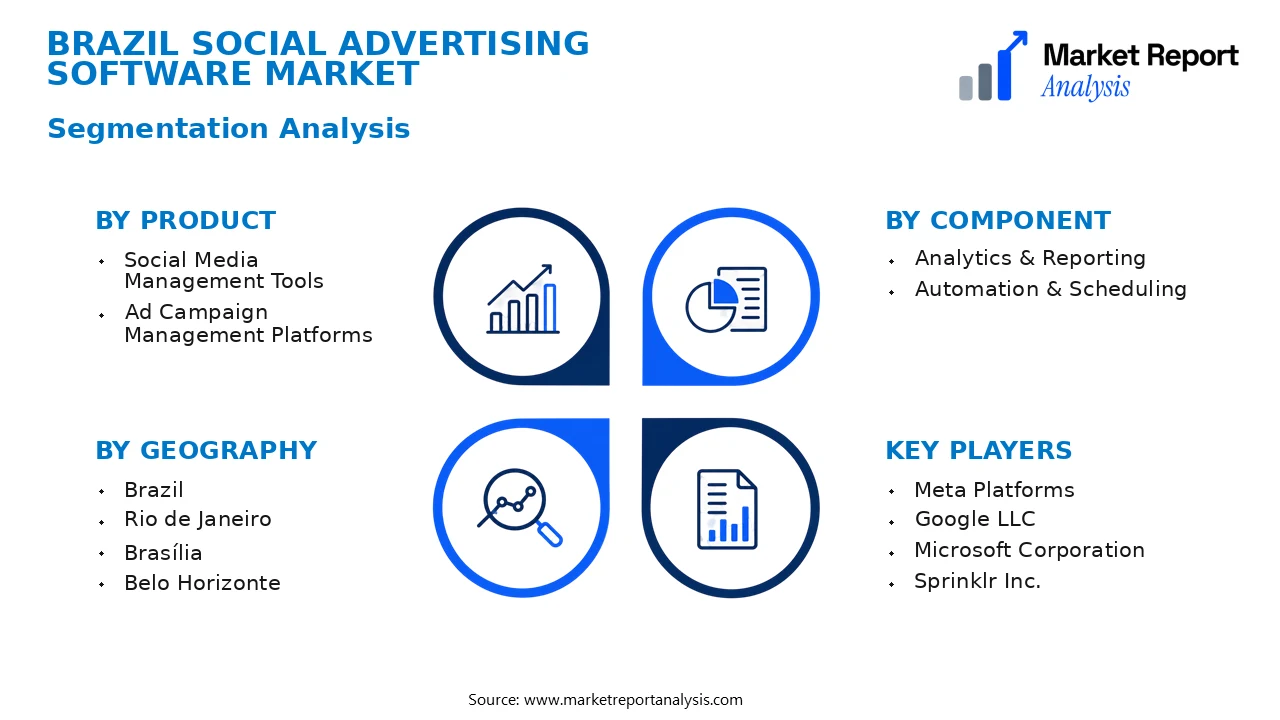
- Product
- Social Media Management Tools: These are integrated platforms that facilitate managing, scheduling, and analyzing social media campaigns across multiple channels, essential for enterprises aiming to streamline digital marketing efforts and optimize ad performance.
- Ad Campaign Management Platforms: Specialized software focused on creating, executing, and tracking social advertising campaigns, providing analytics and targeting tools critical for maximizing ROI and enhancing targeting precision.
- Component
- Analytics & Reporting: These components enable marketers to measure campaign effectiveness, audience engagement, and conversion metrics, which are pivotal for refining strategies and demonstrating ROI to stakeholders.
- Automation & Scheduling: Supporting automation of posting and ad placements, this component reduces manual effort and ensures timely delivery of campaigns aligned with peak engagement periods.
- Application
- Brand Awareness: Campaigns designed to increase visibility and recognition across social platforms, vital for new product launches and sustaining brand presence in competitive markets.
- Lead Generation: Focused on capturing customer information and interest through targeted ads, this application is crucial for expanding customer databases and nurturing sales pipelines.
- Customer Engagement: Facilitates ongoing interaction with consumers via social ads, fostering loyalty and feedback, crucial for maintaining long-term customer relationships and brand trust.
- End User
- Large Enterprises: These organizations possess extensive advertising budgets and complex social media strategies, requiring sophisticated tools for managing multiple campaigns and analyzing large data sets.
- Small and Medium-sized Enterprises (SMEs): They typically utilize more affordable, user-friendly software solutions to execute localized social advertising campaigns with limited resources.
- Geography
- Brazil
- São Paulo: The financial and commercial hub with a high concentration of corporations and tech firms, demonstrating the highest demand for social advertising solutions.
- Rio de Janeiro: Known for its vibrant consumer market and tourism industry, this city exhibits significant social media advertising activity driven by lifestyle and entertainment sectors.
- Brasília: As the political capital, its government institutions and related agencies require specialized software for communication and public engagement campaigns.
- Belo Horizonte: An emerging market with growing digital infrastructure, attracting investments in social media marketing by local businesses and startups.
- Brazil
Competitive Intelligence
The Brazil Social Advertising Software Market exhibits moderate competition with a mix of global technology giants and local players vying for market share. Dominance is somewhat concentrated among leading firms, although regional variants influence competitive dynamics, especially in major Brazilian cities such as São Paulo, Rio de Janeiro, and Brasília. Companies pursue aggressive business strategies, focusing on product innovation, platform integrations, and bespoke solutions tailored for the Brazilian digital ecosystem. Recent innovations include AI-driven ad targeting and enhanced analytics tools to optimize campaign performance. Strategic partnerships with local media agencies, telecom providers, and e-commerce platforms are increasingly common, aiming to expand user reach and data access. Mergers and acquisitions are also on the rise, with larger players acquiring niche startups to diversify offerings and bolster their technological capabilities. Firms invest heavily in R&D to differentiate through superior user interfaces and more robust data privacy measures aligned with evolving regulations. Such competitive activities underpin the market's growth trajectory and regional differentiation, especially as urban centers seek increasingly sophisticated advertising solutions.
Leading Company Profiles
The competitive landscape in the Brazil social advertising software market is marked by a blend of global technology giants and innovative local firms, emphasizing product diversity, advanced technological design, and strategic regional deployment. These companies are focusing their efforts on expanding their technological capabilities, improving user experience, and forming strategic alliances to boost their market presence in Brazil and Latin America.
- Meta Platforms
- Google LLC
- Microsoft Corporation
- Sprinklr Inc.
- Hootsuite Inc.
- EngageLab Tecnologia
- RD Station
- Sociabble
- Falcon.io
- Zoho Corporation
Meta Platforms
Meta Platforms offers leading social advertising solutions through Facebook and Instagram advertising tools, focusing on targeting, analytics, and campaign management to help brands reach billions of users efficiently in Brazil.
Google LLC
Google provides comprehensive social advertising integrations within its Google Ads platform, enabling businesses in Brazil to optimize multi-channel campaigns with powerful data-driven insights and automation features.
Microsoft Corporation
Microsoft’s social tools are embedded within the LinkedIn suite, offering advanced B2B targeting options and analytics, crucial for enterprise clients looking to leverage social media for professional marketing in Brazil.
Sprinklr Inc.
Sprinklr specializes in customer experience management, notably in social media engagement and social advertising, aligning with brands aiming for unified customer journeys and insights across multiple social channels.
Hootsuite Inc.
Hootsuite’s platform enables scheduling, monitoring, and analytics for multiple social networks, focusing on ease of use and analytics depth, making it popular among SMBs and large enterprises in Brazil.
EngageLab Tecnologia
EngageLab delivers locally tailored social advertising platforms with strong automation and real-time monitoring capabilities, focusing on enhancing Brazilian advertisers’ campaign efficiency and data analytics.
RD Station
RD Station offers integrated marketing automation solutions, including social media management, vital for Brazilian companies seeking to unify digital marketing efforts across channels and optimize social ad spend.
Sociabble
Sociabble provides employee advocacy and social media amplification tools, enabling brands in Brazil to increase reach and engagement via social sharing and influence amplification strategies.
Falcon.io
Falcon.io delivers an integrated platform for social media listening, engagement, and advertising, helping brands in Brazil monitor trends, engage audiences, and optimize advertising efforts efficiently across social platforms.
Zoho Corporation
Zoho offers a suite of AI-powered social media marketing and management tools aimed at SME sectors in Brazil, supporting campaign scheduling, analytics, and automation to streamline digital marketing efforts.
Strategic Business Developments
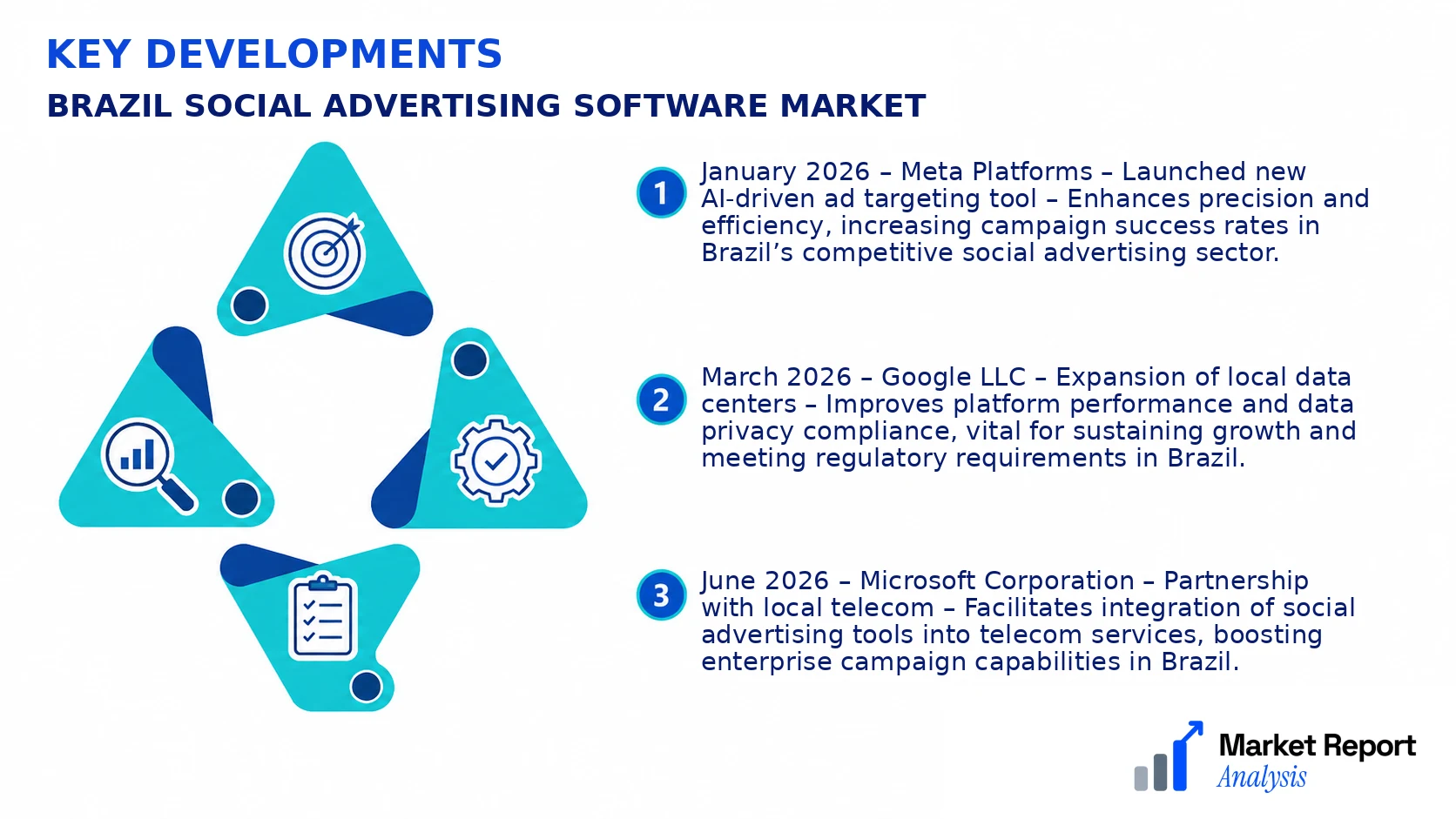
- January 2026 – Meta Platforms – Launched new AI-driven ad targeting tool – Enhances precision and efficiency, increasing campaign success rates in Brazil’s competitive social advertising sector.
- March 2026 – Google LLC – Expansion of local data centers – Improves platform performance and data privacy compliance, vital for sustaining growth and meeting regulatory requirements in Brazil.
- June 2026 – Microsoft Corporation – Partnership with local telecom – Facilitates integration of social advertising tools into telecom services, boosting enterprise campaign capabilities in Brazil.
- August 2026 – Sprinklr Inc. – Acquisition of a local analytics startup – Strengthens Sprinklr’s AI analytics capacity, enabling more sophisticated social campaign insights for Brazilian brands.
- October 2026 – EngageLab Tecnologia – Launch of mobile-focused social advertising suite – Addresses rising mobile social media usage, providing localized solutions tailored to Brazil’s digital consumption trends.
Frequently Asked Questions
What is the Brazil Social Advertising Software Market?
The Brazil Social Advertising Software Market comprises digital platforms and tools that facilitate social media advertising for businesses and marketers in Brazil, enabling targeted campaigns, analytics, and automation to enhance advertising efficiency and ROI across major social networks.
What is the current market size of Brazil Social Advertising Software Market?
By 2026, the market is valued at approximately USD 2.8 Billion, reflecting rapid adoption of social media advertising solutions driven by increased digital engagement, mobile usage, and the growing need for targeted marketing strategies within Brazil’s dynamic digital economy.
What factors are driving the Brazil Social Advertising Software Market?
Key drivers include rising internet and social media penetration, advancements in AI and data analytics, a surge in digital marketing budgets, and increasing demand for personalized advertising campaigns, which collectively boost market expansion and software adoption across Brazil’s diverse industries.
Which region dominates the Brazil Social Advertising Software Market?
Southeast Brazil, notably Sao Paulo, dominates the market due to its dense population, high digital activity, and concentration of corporate headquarters, acting as the primary hub for social media advertising activities and software investments in the country.
Which segment is expected to grow the fastest?
The small and medium-sized enterprise (SME) segment is projected to witness the fastest growth owing to increasing awareness of social advertising benefits, affordable software options, and supportive government initiatives to foster digital transformation among SMEs in Brazil.
Who are the leading companies operating in the Brazil Social Advertising Software Market?
Leading players include international tech giants like Facebook and Google, alongside local firms and regional players such as Resultados Digitais and Agendor, who are innovating in social ad tech to cater to Brazil’s unique market needs and consumer behavior trends.
Analyst Perspective
The Brazil Social Advertising Software Market is poised for sustained growth, driven by digital transformation initiatives and increased advertising budgets focused on social platforms. Long-term prospects remain favorable as regional brands and global companies deepen their digital engagement strategies to capture the large, diverse Brazilian consumer base. Technological evolution will continue to favor AI-driven targeting and analytics, offering more precise audience segmentation and campaign optimization, which are crucial for maximizing ROI. Investment priorities should focus on scalable, cloud-based platforms, and innovative automation tools to remain competitive. The sector is characterized by high competitive intensity, with both established players and new entrants vying for market share through strategic partnerships and product differentiation. Growth hotspots include major metropolitan centers such as São Paulo and Rio de Janeiro, where digital adoption is highest, but emerging cities like Brasília and Belo Horizonte also present promising opportunities. Ultimately, regional players that leverage localized data insights and foster strategic alliances will position themselves favorably for sustainable expansion in this evolving landscape.
